
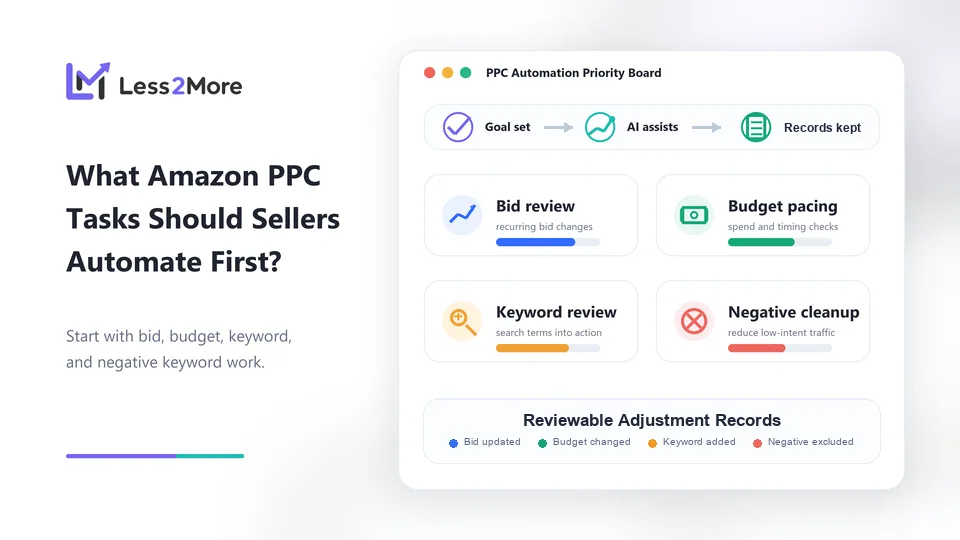
Amazon PPC automation works best when sellers start with the tasks that are repetitive, data-heavy, and easy to delay. Instead of trying to automate every advertising decision at once, sellers can begin with bid review, budget pacing, keyword review, negative keyword cleanup, and adjustment tracking.
Many sellers reach a point where Amazon PPC work is no longer difficult because of one major decision. It becomes difficult because many small decisions keep coming back. A bid needs attention. A budget needs to be checked. A search term needs to be reviewed. A negative keyword should be added. Then the same cycle starts again the next day or the next week.
That is where automation can be useful. The goal is not to remove seller judgment from advertising. The better goal is to reduce the recurring operational work that sellers already know needs to be done, but may not have time to handle consistently.
Automation should start with recurring operations
Not every part of Amazon PPC should be automated in the same way. Campaign strategy, product positioning, pricing, inventory planning, and business goals still require seller judgment. These decisions depend on context that goes beyond campaign data.
The best place to start is usually the operational layer. These are the PPC tasks that rely on repeated checks, performance signals, and ongoing maintenance. They matter, but they are also easy to postpone when sellers are managing products, listings, inventory, customer service, and other parts of the business.
For many sellers, the first automation candidates are bid review, budget pacing, keyword review, and negative keyword cleanup.
Bid review is a strong first candidate
Bid management is one of the most common sources of repetitive Amazon PPC work. Sellers need to review whether bids still match campaign performance, traffic volume, conversion behavior, and advertising goals. A bid that made sense last week may not always make sense this week.
Manual bid review becomes harder as campaign structure grows. More products, campaigns, ad groups, and keywords create more places where bids may need attention. The work is not always complex, but it does require consistency.
AI can help by monitoring performance signals and making recurring bid-related adjustments around the goal the seller sets. The seller still needs to review results and direction, but the daily work of checking every small bid change can become easier to manage.
Budget pacing can protect campaign consistency
Budget management is another area where small checks matter. A campaign may run out of budget too early in the day, or spend may move faster than expected. In other cases, budget may not be used efficiently enough to support the campaign's goal.
When sellers manage budgets manually, they need to keep checking spend, timing, and campaign priority. This is manageable for a small account, but it becomes more demanding as the number of campaigns grows.
Budget pacing is a practical automation target because it is recurring and data-driven. AI support can help sellers keep budget-related actions closer to campaign goals, while adjustment records make it possible to review what changed over time.
Keyword review turns search behavior into action
Amazon PPC is closely connected to search behavior. Sellers often need to review search terms, identify useful traffic, and decide whether certain terms should become keywords. This work can create growth opportunities, but it also takes time.
The challenge is that search term review is rarely a one-time task. New queries appear, product demand changes, and campaign data continues to develop. If sellers only review keywords occasionally, useful terms may be added later than they should be.
Automation can help sellers keep keyword review from falling behind. AI can support recurring keyword-related work, while sellers use adjustment records to see which keywords were added or changed.
Negative keyword cleanup reduces low-intent traffic
Negative keyword work is easy to underestimate. Sellers may focus on finding new keywords, but excluding irrelevant or low-intent traffic is also an important part of PPC maintenance.
Manual negative keyword cleanup requires sellers to review search terms, identify traffic that does not fit the product or campaign goal, and apply exclusions. Like other PPC maintenance tasks, it is not difficult once or twice. It becomes difficult because it needs to be repeated.
This makes negative keyword cleanup another useful automation candidate. AI can help handle recurring cleanup work, while the seller reviews which negative keywords were added and how campaign traffic changes over time.
A practical order for PPC automation
Start with the tasks that are repeated most often: bids, budgets, keywords, and negative keywords. Keep strategy and final judgment with the seller, and use adjustment records to review what changed.
What should remain with the seller
Automation does not remove the need for advertising strategy. Sellers still need to decide what they are trying to achieve, which products deserve more support, how much risk they are comfortable taking, and how advertising fits into pricing, inventory, reviews, and listing quality.
AI can support campaign operations, but it cannot replace the seller's understanding of the business. A campaign result may be affected by seasonality, product competitiveness, listing conversion rate, price changes, review quality, or inventory constraints. These are business factors, not only PPC settings.
A realistic automation workflow keeps the seller involved at the right level. The seller sets the goal. AI handles more of the repetitive operational work. The seller reviews adjustment records and performance direction.
Why adjustment records matter when automation grows
As more PPC tasks become automated, visibility becomes more important. Sellers need to know what changed inside their campaigns. Otherwise, automation can feel like a black box, even if it is saving time.
Recorded adjustment history gives sellers a practical way to stay informed. Instead of trying to remember every manual change, sellers can review actions such as bid updates, budget-related changes, keyword additions, and negative keyword additions.
This does not mean sellers see the specific reason behind every action. It means the actions are visible and reviewable, so sellers can follow how campaign operations changed over time.
Where Less2More fits
Less2More is designed for sellers who want to reduce repetitive Amazon PPC operations without losing visibility into campaign changes. Sellers set the ad goal, and Less2More manages recurring PPC work around that goal, including bids, budgets, keywords, and negative keywords.
Every AI adjustment is recorded for review. That gives sellers a more practical way to use AI in Amazon Ads: less time spent on recurring campaign maintenance, and a clearer record of what changed.
For sellers who are not ready to hand over every advertising decision, this is an important balance. AI can reduce repetitive work, while the seller continues to review campaign direction and business context.
A practical starting point for sellers
If you are considering Amazon PPC automation, do not start by asking which tool can automate everything. Start by asking which recurring tasks are taking the most time and which tasks are easiest to delay.
For many sellers, the answer will be familiar: bids, budgets, keywords, and negative keywords. These are the tasks that keep campaigns moving, but they are also the tasks that can quietly pile up.
When automation starts with these areas and includes reviewable adjustment records, AI becomes easier to adopt. It supports the work sellers already need to do, without asking them to stop paying attention to their advertising.
Ready to automate repetitive Amazon PPC work?
Less2More offers a 30-day free trial of the Starter plan. After the trial, you can choose the plan that fits your Amazon Ads workload and continue using AI Ads automation. No credit card required to start.