
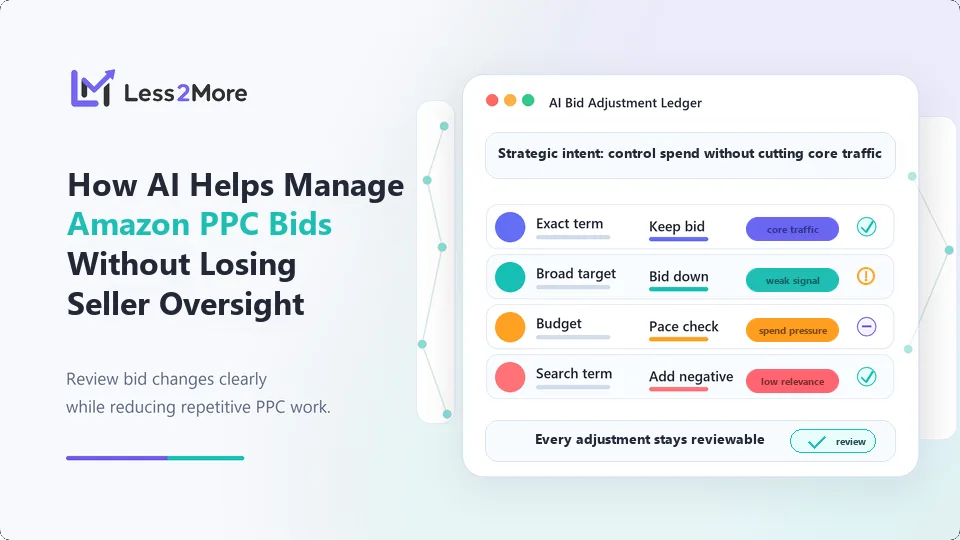
Amazon PPC bid management is repetitive, but sellers should not treat bid automation as a black box. A better workflow is to set the campaign goal, let AI handle recurring bid checks, and review the adjustment records that show what changed.
Note: Less2More helps sellers reduce repetitive Amazon PPC work such as bids, budgets, keywords, and negative keywords, while keeping every AI adjustment recorded for review.
Bid management is one of the first Amazon PPC tasks sellers want to automate, and it is also one of the areas where sellers are most likely to feel nervous. Many small bid changes can quickly affect spend, traffic quality, and campaign direction, so the practical question is not whether AI can change bids. It is whether AI can reduce repetitive work while seller oversight stays in place.
Why Manual Bid Management Fails to Scale Long-Term
Manual bid management can feel manageable when a seller has only a few campaigns. But as products, campaigns, ad groups, keywords, match types, and targets grow, the number of places that may need bid attention increases quickly.
The work is often not complex in isolation. A seller may need to check whether a keyword is spending too much, whether a target has enough conversion signal, whether a launch campaign needs more reach, or whether a mature campaign should become more conservative. The problem is that these checks keep coming back.
When bid review is delayed, campaigns can drift. Some terms may keep spending without enough signal. Other terms may be under-supported even though they are relevant. Budget may move toward traffic that does not fit the campaign goal. Over time, this turns bid management into a recurring operations queue.
Before AI Takes Over, Sellers Must Define Their Strategic Intent
AI support works better when the seller has already defined what the campaign is trying to do. Sellers usually start with a goal such as controlling spend, collecting signals, or maintaining core traffic. AI can then translate that goal into more specific bid behavior.
Before using AI for bid management, sellers should clarify the campaign goal:
- Launch & Exploration: allow enough traffic to collect search term and conversion signals.
- Spend control: avoid aggressive bids on high-spend, weak-signal traffic.
- Efficiency focus: watch bids around terms that spend without converting.
- Rank Maintenance: avoid cutting bids too sharply on relevant terms that still support volume.
This context matters because the same bid action can mean different things. A bid increase may be reasonable in a discovery campaign, but questionable in a cost-control campaign. A bid decrease may reduce wasted spend, but it can also limit valuable traffic if applied too broadly.
How AI Elevates Your Bidding Workflow
AI can help reduce the repeated checking that makes bid management difficult to sustain. It can support recurring work around performance signals, spend patterns, keyword or target behavior, and the goal the seller sets.
In a practical AI-assisted workflow, the seller should not need to open every campaign every day just to check every small bid movement. Instead, AI can handle more of the repetitive bid-related operations, while the seller reviews what changed over time and decides whether the direction still fits the campaign goal.
This is where visible adjustment records are important. Less2More does not ask sellers to trust a hidden black box. Sellers can review which bids were updated and use those records to understand how campaign operations are changing.
In Less2More, those records can include AI actions around bids, budgets, keywords, and negative keywords, so sellers can review the surrounding PPC workflow instead of guessing what changed.
What Sellers Should Review in Bid Adjustment Records
Bid adjustment records become useful when sellers know what to look for. The goal is not to approve every tiny change manually. The goal is to check whether the pattern of changes still makes sense against the seller's campaign goal.
Although this article focuses on bids, sellers should also review nearby Less2More records when the bid pattern looks unusual. Budget-related adjustments and negative keyword actions can help explain whether spend pressure came from broad traffic, weak relevance, or a campaign that needed tighter protection.
1. Which bids changed?
Start with the basic record: which keywords, targets, or campaign areas had bid updates. This gives sellers visibility into where AI is active.
2. Did bid movements match the goal?
If the goal is spend control, sellers should look for whether high-spend, weak-signal terms are being handled more cautiously. If the goal is reach or discovery, sellers can check whether relevant traffic is still supported.
3. Are the affected terms still relevant?
Bid changes should not be reviewed without context. A high-spend keyword may still be valuable if it is relevant and supports the campaign goal. A low-performing term may deserve a more cautious bid if it keeps consuming budget without enough signal.
4. Does the pattern match the guardrails?
The most useful review question is simple: Are bid changes supporting the goal the seller set? If the answer is yes, the seller may not need to intervene. If the answer is unclear, the next review cycle should focus on those records.
When Sellers Should Intervene
AI bid management should not remove seller judgment. It should reduce repetitive bid work while making it easier for sellers to notice when the direction needs adjustment.
Sellers may want to intervene when:
- Bids look too aggressive for a campaign focused on spend control.
- High-spend terms keep consuming budget without enough conversion or relevance signal.
- Relevant terms appear to be cut too quickly before enough data has accumulated.
- Bid changes do not match the campaign goal the seller set before launch.
Intervention does not have to mean turning AI off. A more useful response may be to clarify the campaign goal, review high-spend keywords in the next cycle, check budget pacing or negative keyword records, or watch a specific group of terms more closely.
Real-World Scenario: Bid Review for a Mature Desk Organizer Product
In this illustrative scenario, a seller has a desk organizer product that already sells consistently. The weekly advertising budget is assumed to be about $320. This is not a launch campaign. The goal is not to chase more traffic at any cost, but to maintain steady orders while avoiding continued spend on broad, high-click, low-conversion traffic.
After one week, the seller reviews Less2More bid adjustment records in the scenario. Two exact match keywords, such as “desk drawer organizer” and “office desk organizer tray,” remain close to their original bid levels because they are highly relevant and still represent core traffic. At the same time, two broad match targets with higher click spend and weaker conversion signals are marked for a reviewable bid reduction of about 10-18%. This percentage is used only to make the workflow concrete, not as a verified performance result.
The seller also checks nearby records instead of treating bid changes in isolation. If budget records show repeated spend pressure from broad traffic, or negative keyword records show irrelevant terms being excluded, the seller can understand the bid pattern as part of a broader PPC workflow rather than a standalone bid move.
The point of this scenario is not to claim that performance has already improved, or that ACOS has already moved in the right direction. It shows how a seller can review whether AI actions still match the campaign goal: useful traffic was not cut too quickly, while weaker broad traffic was handled more cautiously. The next step is to keep the current goal, watch another review cycle, and check whether broad target spend starts declining as expected, whether ACOS needs further follow-up against the target range, and whether exact terms continue to receive stable visibility.
A Better Bid Workflow: Set the Goal, Review the Records
The real value of AI-assisted bid management is not that sellers stop caring about bids. It is that sellers spend less time on repetitive bid checks and more time reviewing whether bid, budget, keyword, and negative keyword actions still match the campaign goal.
A practical workflow looks like this:
- The seller defines the campaign goal and risk tolerance.
- AI handles recurring bid-related work around that goal.
- The seller reviews bid adjustment records to understand what changed.
- If the pattern looks right, the seller keeps the goal. If the pattern looks wrong, the seller adjusts the guardrails.
This keeps the seller involved where judgment matters, while reducing the daily repetitive work that makes manual Amazon PPC management hard to sustain.
Ready to Reduce Repetitive Amazon PPC Bid Work?
Start with Less2More, set your campaign goal, and review every AI bid adjustment record as your campaign develops.
Less2More is currently free to use. No credit card required.