
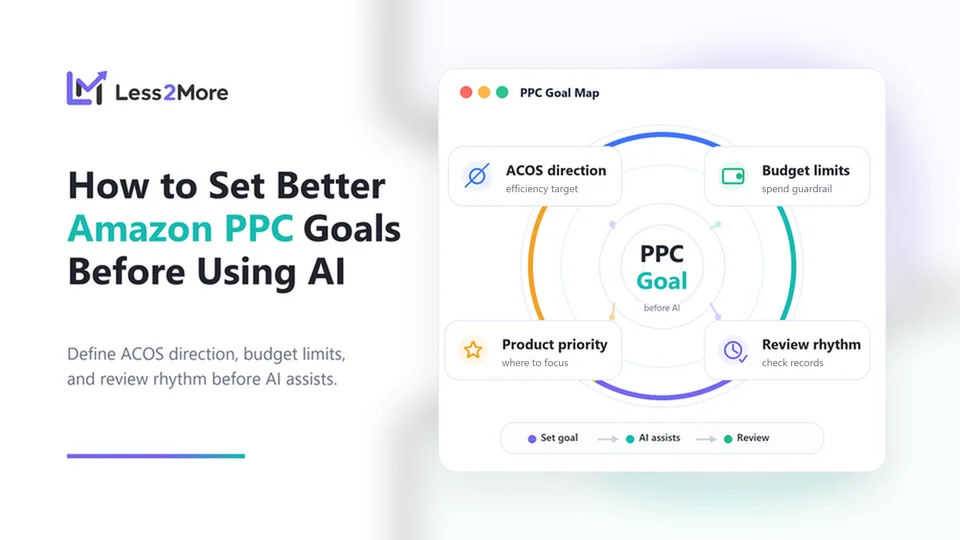
AI can help reduce repetitive Amazon PPC work, but it works best when sellers give it a clear direction. Before using AI for bids, budgets, keywords, or negative keywords, sellers should define what the campaign is trying to achieve, what limits matter, and how results will be reviewed.
Many sellers think about AI advertising in terms of automation first. They ask what AI can adjust, how quickly it can react, and whether it can reduce the amount of daily PPC work. Those are useful questions, but they are not the best starting point.
The better starting point is the campaign goal. If the goal is unclear, even a helpful PPC adjustment can be difficult to judge. A bid increase may look aggressive in one campaign and reasonable in another. A budget shift may support growth for one product and create risk for another. Keyword expansion may be useful when the seller wants more reach, but less useful when the priority is tighter spend control.
That is why Amazon PPC goal setting matters before AI enters the workflow. AI can manage repetitive operations more effectively when the seller has already defined the direction.
AI needs a goal before it can support the work
Amazon PPC is not one single objective. Sellers may use ads to launch a new product, defend ranking, increase sales volume, test search demand, improve efficiency, or support a mature product that already has steady organic traffic. Each situation can lead to different PPC decisions.
For example, a seller launching a new product may accept a higher ACOS for a period of time because visibility and data collection matter. A seller managing a mature product may care more about stable spend and controlled ACOS. A seller with limited inventory may avoid aggressive budget expansion even if traffic looks promising.
If these goals are not defined, automation can feel confusing. Sellers may review an adjustment and ask whether it was good or bad, but the answer depends on what the campaign was supposed to do.
Start with the business role of the campaign
Before setting an AI-assisted PPC workflow, sellers should clarify the role of the campaign. Is it meant to support a launch? Protect a profitable product? Improve efficiency? Explore new keyword opportunities? Reduce wasted spend?
This business role matters because PPC settings do not exist in isolation. A campaign may look inefficient on paper but still be useful if it is supporting a launch, testing search terms, or helping a product gain early visibility. Another campaign may have acceptable sales volume but still need tighter control if margin is limited.
A simple way to frame the goal is to ask: What should this campaign help the business do over the next few weeks? The answer gives AI a clearer operating direction and gives the seller a better standard for review.
ACOS should be a direction, not a magic number
Many sellers use ACOS as the main PPC goal, which makes sense because it connects ad spend with attributed sales. But ACOS should not be treated as a magic number that applies equally to every product, campaign, or stage of growth.
A realistic ACOS direction depends on product margin, launch stage, organic ranking, competition, pricing, conversion rate, and inventory. A new product may need more room to gather data. A mature product may need a tighter target. A low-margin product may need a different standard than a high-margin product.
For AI-assisted PPC, it is often more practical to define an ACOS direction than to expect perfect precision. Sellers can decide whether the campaign should prioritize more controlled spend, more traffic growth, or a balance between sales volume and efficiency.
Budget limits shape what AI can do
Budget is another important goal-setting input. If the budget is too tight, even good PPC opportunities may be limited. If the budget is too loose, spend may move faster than the seller is comfortable with. Either way, AI needs guardrails.
Sellers should define how much daily or weekly spend is acceptable, which campaigns deserve more support, and whether budget should be used cautiously or more actively. This is especially important when several campaigns are competing for attention across different products.
Clear budget limits help make adjustment records easier to review. If a budget-related action appears in the record, the seller can compare it with the campaign's budget role instead of judging it in isolation.
Product priority should come before automation
Not every product deserves the same PPC attention at the same time. Some products may be strategic launches. Some may be seasonal. Some may have healthy margin and strong conversion. Others may be limited by inventory, weak reviews, or listing issues.
This matters because AI can support campaign operations, but it should not be expected to decide the seller's business priorities. Sellers should identify which products should receive more PPC support and which products should be managed more conservatively.
When product priority is clear, sellers can better understand whether bid, budget, keyword, and negative keyword adjustments are aligned with the larger business context.
Keyword expectations should be realistic
Keyword and search term work is one of the most repetitive parts of Amazon PPC. Sellers need to identify useful search terms, add relevant keywords, and exclude traffic that does not fit the product or campaign goal.
Before using AI support, sellers should decide what kind of keyword behavior they want. Is the campaign expected to discover new search opportunities? Should it focus on proven terms? Should it clean up low-intent traffic more aggressively? Should it avoid expanding too quickly while the seller reviews performance?
These expectations help sellers review AI actions more clearly. A keyword addition, bid update, or negative keyword action should be judged against the campaign goal, not only as an isolated change.
A practical PPC goal-setting checklist
- What product or campaign needs attention first?
- Is the goal traffic growth, spend control, launch support, or balanced optimization?
- What ACOS direction is acceptable for this campaign stage?
- What budget limits should guide campaign actions?
- How often will adjustment records be reviewed?
Review rhythm keeps sellers involved
Goal setting should also include a review rhythm. Sellers do not need to inspect every small PPC action every hour, but they should have a regular way to check whether campaign direction still matches the business goal.
A weekly review may be enough for some campaigns. Other campaigns, such as launches or high-spend products, may need closer attention. The right rhythm depends on budget, risk level, product stage, and how quickly campaign data is changing.
The important point is that AI should reduce repetitive hands-on work without removing seller oversight. A regular review habit helps sellers stay connected to the campaign while spending less time on daily manual maintenance.
Adjustment records turn goals into something reviewable
Once a goal is set, adjustment records become more valuable. Sellers can review what changed and compare those actions with the campaign direction they defined earlier.
Useful records may show bid updates, budget-related changes, keyword additions, negative keyword additions, and when those actions happened. This does not mean sellers receive the full reason behind every action. It means the seller has a visible history of the actions that affected the campaign.
Reviewable adjustment records help sellers connect AI actions with campaign goals. That connection is what makes AI support easier to adopt in Amazon PPC.
Where Less2More fits
Less2More is designed around a practical workflow: the seller sets the goal, AI manages repetitive PPC work, and the seller reviews the adjustment records. This keeps the seller involved at the strategy and review level, while reducing the time spent on recurring bid, budget, keyword, and negative keyword operations.
For sellers who want to use AI in Amazon Ads, this goal-first approach is important. It helps prevent automation from feeling disconnected from the business. Instead of asking AI to make every advertising decision, sellers can give it a clear direction and review how campaign operations changed over time.
A clearer goal makes AI easier to trust
AI can be useful in Amazon PPC, but it should not begin with a vague instruction to simply improve performance. Sellers get more practical value when they define the campaign role, ACOS direction, budget limits, product priority, keyword expectations, and review rhythm first.
With those inputs in place, AI support becomes easier to evaluate. Sellers can review whether adjustments are consistent with the goal, whether campaign direction still makes sense, and whether business context has changed.
That is a more realistic way to use AI for Amazon Ads: clear goals, reduced repetitive work, and visible adjustment records.
Ready to set a clearer Amazon PPC goal?
Less2More offers a 30-day free trial of the Starter plan. After the trial, you can choose the plan that fits your Amazon Ads workload and continue using AI Ads automation.