
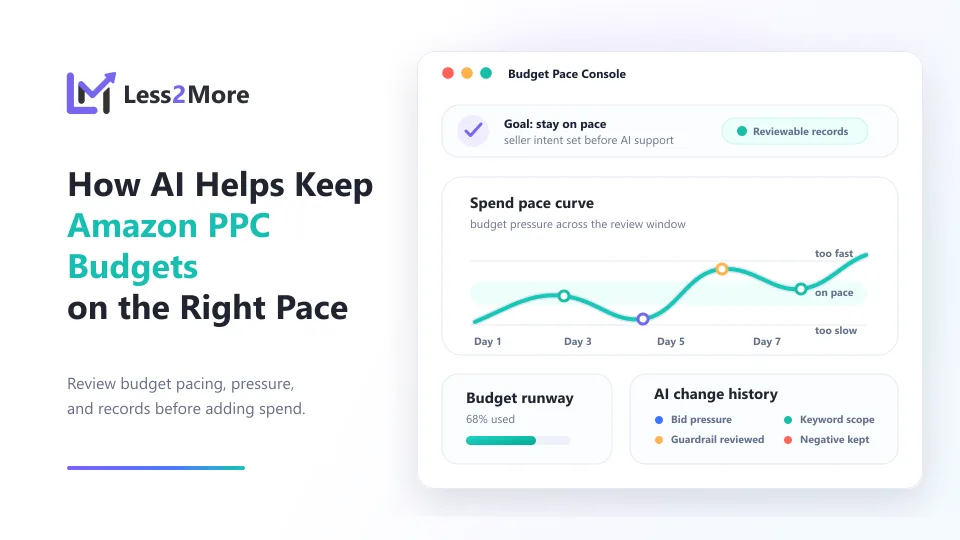
Amazon PPC budget pacing means tracking how quickly a campaign uses its budget and whether that spending pattern matches the campaign goal. It is not just about setting a daily budget; sellers also need to know whether campaigns run out of budget too early, spend too slowly to collect useful data, or use budget in ways that no longer support the original advertising goal.
Less2More helps sellers reduce repetitive Amazon PPC work across bids, budgets, keywords, and negative keywords while keeping AI adjustment records visible for later review.
Budget issues are often noticed too late. A campaign may run out of budget before enough search term data is collected. A test budget may be spent too quickly on broad, weak-signal traffic. Or a campaign may barely spend at all, leaving the seller without enough data to evaluate bids, keywords, or search behavior.
That is why budget management should not stop at one question: "Should I increase the budget?" A more useful question is: "Is this budget being used at the right pace for the campaign's goal?"
Budget Pacing Is More Than a Daily Budget Number
A daily budget is a limit. Budget pacing is the pattern of how that limit is used. Two campaigns can both have a daily budget of $50 and still behave very differently. One may spend most of the budget early in the day. Another may spend slowly and fail to collect useful signals. A third may spend steadily, but on search terms that do not fit the product.
For Amazon sellers, this distinction matters because pacing affects what a campaign can learn and when the seller can review it. A good budget review connects three things: the campaign goal, the spending pattern, and the adjustment records. The seller is not approving every small change manually. The seller is checking whether budget actions still support the intended direction.
Set the Budget Intent Before Reviewing AI Actions
AI support works better when the seller has already defined what the budget is supposed to do. The same pacing pattern can be acceptable in one campaign and risky in another. A launch campaign may need more room to collect signals. A mature campaign may need steadier control. A low-budget test may need protection from early spend spikes.
Before using AI support for budget pacing, sellers should clarify the campaign's budget intent:
- Discovery: allow enough budget to collect search term and conversion signals.
- Spend control: prevent weak-signal traffic from consuming budget too quickly.
- Traffic maintenance: keep core campaigns visible without forcing broad expansion.
- Budget protection: avoid repeated early budget exhaustion on irrelevant or low-intent traffic.
This intent becomes the review standard. A budget increase, hold, or related adjustment should be judged against the campaign's purpose, not treated as automatically good or bad.
Scenario 1: A Campaign Runs Out of Budget Too Early
A campaign that becomes budget-limited too early may miss later search behavior, making the seller's review less complete. The key question is whether the early exhaustion comes from relevant demand, broad traffic, or terms that need tighter control.
Less2More keeps budget-related AI adjustments recorded beside bid, keyword, and negative keyword actions. If the traffic is relevant and the campaign is in discovery mode, the seller may allow more budget room. If the goal is spend control, the seller may tighten guardrails or review high-spend targets before increasing the budget.
Scenario 2: Budget Is Being Spent Too Aggressively
A campaign can stay within its daily budget and still spend too aggressively. Sellers should watch for spend concentrated in a short period, broad match areas consuming budget quickly, or high-spend traffic without enough relevance or conversion signal.
Recorded adjustments make the review more practical than looking at spend alone. If aggressive spend supports a discovery goal, the seller may keep the intent unchanged for the next cycle. If spend is moving into weak traffic, the seller can refine the goal, review bids, or strengthen negative keyword guardrails.
Scenario 3: A Campaign Barely Spends Its Budget
Low spend is not always a budget problem. It can come from cautious bids, narrow keyword coverage, limited demand, or a campaign structure that does not match buyer intent.
Budget records become more useful when reviewed with other Less2More adjustment records. If relevant keywords are being added or bids are being adjusted, the campaign may be opening gradually. If there are few meaningful changes, the seller may need to revisit the campaign goal or bid and keyword guardrails.
Scenario 4: Budget Pacing Does Not Match the Campaign's Role
Budget pacing should be reviewed by campaign role. A launch campaign, mature efficiency campaign, branded defense campaign, and limited-budget test should not be judged by the same spend pattern.
Because pacing issues often come from surrounding PPC work, sellers should review budget actions alongside bid, keyword, and negative keyword changes. If the role is unclear, the first step is to refine the strategic intent before changing the budget.
Scenario 5: Budget Changes Are Hard to Review Later
Budget management becomes risky when sellers cannot reconstruct what changed. If spend behavior shifts, the seller needs to know whether it came from budget adjustments, bid movements, keyword expansion, negative keyword actions, or a combination of those changes.
Less2More keeps AI adjustments recorded so sellers can review the pattern instead of relying on memory. If the records show actions drifting away from the goal, the seller can tighten guardrails. If the pattern is reasonable, the seller can keep the current direction and define what to watch next.
What Sellers Should Review Weekly
A weekly budget pacing review does not need to be complicated. The goal is to build a repeatable rhythm that helps sellers decide whether to keep the current direction, adjust guardrails, or review a specific campaign more closely.
Each week, sellers can review:
- Budget exhaustion: which campaigns ran out of budget too early or too often.
- Spending pattern: whether budget was used steadily, too quickly, or too slowly.
- Traffic quality: whether budget went toward relevant terms, broad traffic, or weak-signal areas.
- Related PPC actions: which bids, keywords, and negative keywords changed during the same period.
- Goal alignment: whether budget-related actions still match the seller's strategic intent.
This weekly review also helps sellers identify which Amazon PPC automation tasks can reduce repetitive budget, bid, keyword, and negative keyword checks.
This review keeps the seller involved where judgment matters. AI can help reduce repetitive budget monitoring, but the seller still decides whether the campaign direction is acceptable.
Hypothetical Example Scenario: A Launch Campaign With Unstable Budget Pacing
In this illustrative scenario, a seller launches a new storage product with a weekly PPC test budget of about $280. The seller's intent is to collect early search term data while avoiding a pattern where the daily budget is spent too quickly on broad, weak-signal traffic. This is a workflow example, not a verified customer result.
After one week, the seller reviews Less2More adjustment records. The campaign ran out of budget early on several days, and most of the spend pressure came from one broad match area. During the same period, a relevant long-tail term was added as a keyword, two irrelevant search terms were added as negative keywords, and one high-spend area received a reviewable bid adjustment.
The seller does not treat the next step as simply raising the budget. First, they check whether the pacing pattern matches the launch intent. If the broad traffic is being handled more cautiously and the new long-tail keyword looks relevant, the seller may keep the goal in place for another review cycle. If weak traffic continues to exhaust budget early, the seller may tighten guardrails before adding more budget.
A Better Budget Workflow: Set the Goal, Review the Records
The value of AI support in Amazon PPC budget management is not that sellers stop caring about spend. It is that sellers spend less time repeating the same budget checks and more time reviewing whether campaign operations still match the goal.
A practical workflow looks like this:
- The seller defines the campaign's budget intent and risk tolerance.
- AI helps handle repetitive budget checks and related PPC work.
- The seller reviews visible adjustment records to see what changed.
- If the budget pacing matches the goal, the seller keeps the direction. If it does not, the seller adjusts the guardrails.
This keeps oversight in the seller's hands. You set the goal. AI helps handle the repetitive work. You review the adjustment records.
Ready to Keep Amazon PPC Budgets on Track?
Start with Less2More, set your campaign goal, and review AI adjustment records as your campaigns develop.
New users can follow this step-by-step Less2More setup guide before starting their first Amazon Ads workflow.
Less2More is currently free to use. No credit card required.